蹲跳的「一点点下沉」:2% 还是 5%? That Small Dip in a Squat Jump: 2% or 5%?
蹲跳(SJ)的意义在于测量纯向心发力——没有下蹲,没有拉长-缩短周期(SSC)。但真实受试者几乎总会有微小的下沉(dip):文献报告 99.2% 的 SJ 都存在某种程度的下沉。多小才算「还可以」?目前只有一篇论文正面回答了这个问题。它给出了一个阈值,但这个阈值的实际意义,需要单独讨论。 The squat jump exists to measure purely concentric force production — no dip, no stretch-shortening cycle. But real people almost always sink a little: 99.2% of squat jumps contain some unweighting. How small is small enough? We read the one paper that answers this directly. It gives a number — and a question of scale that is easy to miss.
先给结论The short version
下沉 <2% 体重 — 干净的 SJ,正常使用。 Dip below 2% BW — a clean SJ. Use it.
下沉 2–5% 体重 — 可用,但把幅度记下来。单次影响很小;同一个人跨时间、或两个人之间比较时要确认幅度相近。 Dip 2–5% BW — usable, but record the amplitude. The effect on one trial is small; check the dips are comparable before tracking over time or comparing two athletes.
下沉 >5% 体重 — 重测。此时已不属于姿势晃动,而是一次实质性的反向动作。 Dip above 5% BW — re-test. That is no longer postural sway but a genuine countermovement.
三档的依据、以及未采用文献推荐的 2% 作为拒绝线的原因,见后文。以下先说操作。 The evidence behind those bands — and why we don't reject at the literature's 2% — comes later. First, what to actually do.
测试时怎么做Running the test
测试前Before
- 先练,再测。SJ 是一项技能。Petrigna 等(2019)建议起跳前保持蹲姿 2 秒再跳;Hawkin 明确指出这是可以通过练习掌握的。多数被判「反向下沉」的试次,问题是不熟悉流程,不是能力。 Familiarise before you measure. The SJ is a skill. Petrigna et al. (2019) recommend holding the squat 2 s before jumping; Hawkin note explicitly that this is learnable. Most trials flagged for a countermovement are unfamiliarity, not incapacity.
- 固定蹲的深度。原论文用橡皮筋标在力台后缘、约 90° 膝角来统一深度。深度一旦变化,前后测试即失去可比性。此项的影响大于下沉幅度。 Fix the squat depth. The source study used a rubber band at a standardised depth, roughly 90° knee angle. If depth drifts, comparison breaks down — and that matters more than the dip does.
- 口令要具体。「不要先往下沉,从静止的位置直接向上跳」比「做一个蹲跳」有效得多。 Cue precisely. "Don't dip first — jump straight up from the still position" works far better than "do a squat jump."
测试中During
- 不要只盯着人看。论文引用的数据:肉眼观察只能识别出 61.4% 的有下沉试次,而实际有下沉的比例是 89.6%。即约三分之一的下沉无法用肉眼识别。力台的价值正在于此。 Don't rely on watching. The paper cites gross visual observation detecting only 61.4% of trials with unweighting, when 89.6% actually contained one. Roughly a third of countermovements are invisible to the eye. This is precisely what the force plate is for.
- 当场重测,不要留到事后。下沉超过 5% 应当场补测,此时运动员在场、热身状态尚存。若留待事后从数据中剔除,只会留下一个缺口。 Re-test on the spot, not afterwards. If the dip exceeds 5%, have them jump again while they are still there and still warm. Culling it from the data later just leaves a hole.
测试后After
- 把下沉幅度和跳跃高度一起存。该数值决定了这次试次的可比范围。仅保留「通过/失败」标记,等于丢弃这一信息。 Store the dip alongside the jump height. It determines who this trial can be compared with. A pass/fail flag throws that information away.
- 纵向追踪时把下沉幅度一并看。如果这次 SJ 比上次高,但下沉也更大,那可能是技术漂移而不是能力提升。 Watch the dip when tracking over time. If an SJ improves but the dip also grew, that may be technique drift rather than improved capability.
三个实际场景Three scenarios
一、青少年队伍筛查1. Screening a youth squad
30 名 14 岁运动员,多数没做过力台测试。若以 2% 判定,可能半数试次需要重测,测试将变成蹲姿教学。 Thirty 14-year-olds, most never tested on a plate. Reject at 2% and you may be re-testing half the squad, turning the session into a positioning lesson.
做法:正式测试前给 2–3 次练习跳,明确口令。正式测试用 5% 门槛。把下沉幅度存进档案——第一次测试的下沉普遍偏大是正常的,几周后再测时它本身就是一个进步指标。 Approach: give 2–3 practice jumps with an explicit cue, then test at the 5% gate. Store the dip: large dips at first testing are normal, and on a re-test weeks later the dip itself is a progress measure.
二、ACL 术后康复的左右对比2. Limb symmetry in ACL rehab
这是最需要小心的场景。术后单腿 SJ 常用来算左右对称性指数(LSI),而患侧往往更难保持静止——恰恰是它更容易出现下蹲。 This is where care matters most. Single-leg SJ is often used for a limb symmetry index after surgery, and the involved limb is usually the one that struggles to hold still — so it is the one more likely to dip.
如果患侧下沉更多、因而高度被略微抬高,LSI 会低估两侧差距——即康复进度被报得比实际乐观,而这一偏差方向恰恰最不容出错。 If the involved limb dips more and its height is thereby nudged up, the LSI understates the deficit — reporting rehab as further along than it is, in the one direction that carries risk.
做法:左右两侧的下沉幅度都要看,并且要求两侧相近再去解读 LSI。差距大就先重测,不要直接算比值。 Approach: read the dip on both limbs and require them to be comparable before interpreting the LSI. If they differ, re-test rather than computing the ratio.
三、赛季中的 EUR 监控3. Tracking EUR across a season
EUR(离心利用率)= CMJ ÷ SJ,SJ 是分母。下沉抬高 SJ,EUR 就被压低——运动员看起来 SSC 获益比实际更少。抬高 SJ 高度「会影响 EUR 的计算,掩盖训练带来的适应」。 EUR = CMJ ÷ SJ, and the SJ is the denominator. A dip inflates the SJ, so EUR is deflated — the athlete appears to gain less from the SSC than they do. The paper says so itself: inflating SJ height "would affect the calculation of EUR, masking training-induced adaptations."
单次跳跃里 0.02 m 的偏差可以忽略;但如果某人每次测试都稳定地沉 4%,这一偏差即成为固定的系统误差,随 EUR 贯穿整个赛季。 A 0.02 m bias is negligible in one jump. But if an athlete sinks 4% at every session, it becomes a constant systematic offset that rides along with EUR all season.
用哪个跳跃高度?Which jump height?
力台通常给出两个高度:冲量-动量法(对起跳前整段力曲线积分)和腾空时间法(只看离地到落地)。二者在此处的差别不可忽略。 A force plate typically reports two heights: impulse–momentum (integrating the whole force trace up to takeoff) and flight time (measuring only the airborne interval). The distinction matters here.
Agar-Newman 等(2025)用的是冲量-动量法(Linthorne 法)。冲量-动量法也是对下沉最敏感的算法——下沉本身就进入积分:先是负冲量,随后制动阶段是正冲量。腾空时间法则完全「看不见」下沉,它只计算人在空中多久。(这一点是我们从其方法学推出的,论文本身没有讨论两种算法之间的转换。) Agar-Newman et al. (2025) used impulse–momentum (the Linthorne method). It is also the method most sensitive to a dip, because the dip enters the integral directly — negative impulse first, then positive during braking. Flight time never sees the dip; it only counts time in the air. (That is our reading of their methods — the paper does not discuss how the threshold transfers between the two calculations.)
力台测试推荐用冲量-动量法。2% 的发现基于冲量-动量法,完全适用;下沉幅度要认真看。 For force-plate testing, use the impulse method. The 2% finding is based on it and applies in full; the dip deserves attention.
腾空时间法不作推荐,原因和下沉无关:它默认离地与落地的姿态相同。一旦在空中收腿、或落地时蹲得更低,腾空时间就变长而重心位移并没有增加——高度被高估。业余训练者常见的摆臂跳、落地姿势不固定,正好会放大这个误差。接触垫没有力信号,只能如此计算;已有力台则无需退回这一方法。 Flight time is not recommended, for reasons unrelated to the dip: it assumes takeoff and landing posture are identical. Tuck the legs in the air or land in a deeper squat and flight time lengthens with no extra centre-of-mass displacement — height is overestimated. Recreational jumpers, who swing their arms and land inconsistently, are exactly the population that inflates this error. Flight time suits contact mats, which have no force signal; with a force plate there is no reason to fall back to it.
另外,EUR 本身既可以用跳跃高度算,也可以用峰值功率算。该研究只验证了下沉对跳跃高度的影响,力、功率、速度列为未来工作。基于功率的 EUR,2% 这个数没有证据支持。 EUR itself can be computed from jump height or from peak power. The study validated the effect of unweighting on jump height only, and the authors list force, power and velocity as future work. So for a power-based EUR, the 2% figure has no evidence behind it yet.
做法:把下沉幅度和 EUR 画在一起。EUR 变化时先问一句:是 SSC 变了,还是 SJ 的执行变了? Approach: plot the dip alongside EUR. When EUR moves, ask first whether the SSC changed or the SJ execution did.
证据:为什么是 5%,不是 2%The evidence: why 5%, not 2%
这个问题最初来自我们自己的数据:几次 SJ 被判为「分析失败」,提示检测到反向下沉,但下沉幅度都只有体重的 5.0–5.1%。受试者为青少年与中年业余爱好者。这一人群训练量不低,也参加比赛,但要将蹲姿保持得完全静止本就不易。 The question came out of our own data: several squat jumps flagged as failed for a countermovement, all of them dipping just 5.0–5.1% of bodyweight. The athletes were youth and middle-aged recreational athletes — people who train seriously and compete, but for whom holding a perfectly static squat is genuinely hard.
| 来源Source | 阈值Threshold | 处理方式Behaviour |
|---|---|---|
| Agar-Newman 等 2025(JSCR)Agar-Newman et al. 2025 (JSCR) | 2% 体重body mass | 超过即统计显著,但效应量极小Above this, statistically significant — but a trivial effect |
| Hawkin Dynamics | 5% 体重bodyweight | 自动判定失败,必须重测Automatic fail, must re-test |
| Petrigna 等 2019(青少年 SOP)Petrigna et al. 2019 (youth SOP) | 无数值No number | 由测试者目视判断Visual inspection by the examiner |
Agar-Newman 等(2025)是目前唯一直接回答这个问题的研究:56 名大学女子橄榄球运动员,4 种负荷下共 937 次蹲跳,按下沉幅度每 1% 分为 6 组,以跳跃高度为因变量、外部负荷为协变量做 ANCOVA。结论是所有 >2% 体重的组都显著高于 ≤1% 参照组(Dunnett 检验,p < 0.01),因此建议以 2% 作为判定阈值。 Agar-Newman et al. (2025) is the only study answering this directly: 56 university female rugby players, 937 squat jumps across four loads, binned by 1% increments into six groups, ANCOVA with jump height as the dependent variable and external load as a covariate. Every group above 2% BM jumped significantly higher than the ≤1% reference (Dunnett's test, p < 0.01), and on that basis they recommend 2% as the threshold.
但这个「显著」有多大?下沉分组的效应量(partial η²)为 0.03,论文用的词是 trivial;同一模型里,外部负荷是 0.62。相对参照组的平均差为:2–3% 组 0.02 m,4–5% 组 0.05 m,>5% 组 0.06 m——而该实验室 SJ 高度的典型测量误差正是 0.02 m。换言之,2–3% 一档的差异落在仪器噪声之内。而 937 次跳跃的样本量,本就足以使很小的效应达到 p < 0.01。 But that significance has to be read against its scale, and the paper is candid: the effect size for unweighting group was η²ₚ = 0.03, which the authors call "trivial" — against η²ₚ = 0.62 for external load. Mean differences versus the reference: 0.02 m at 2–3%, 0.05 m at 4–5%, 0.06 m above 5%. The lab's typical error of measurement is 0.02 m, so the 2–3% difference sits on the noise floor. With 937 jumps, a small effect reaches p < 0.01 easily.
所以我们把拒绝线定在 5%,与 Hawkin 一致,而把 2% 作为提示线。99.2% 的 SJ 存在某种程度的下沉,而该研究自身数据中只有 8.96% 超过 5% 体重。以 2% 拒绝,等于为消除一个 trivial 效应而废弃大量可用试次;以 5% 拒绝,剔除的是那不到 9% 的、差异确已超出噪声的部分。 So we put the rejection line at 5%, matching Hawkin, and treat 2% as a flag. The same paper reports that 99.2% of squat jumps contain some unweighting, while only 8.96% of its own trials exceeded 5% BM. Rejecting at 2% discards a large share of usable trials to remove a trivial effect; rejecting at 5% removes the under-9% whose difference genuinely clears the noise.
为什么污染 SJ 的不是弹性势能Why it isn't about elastic energy
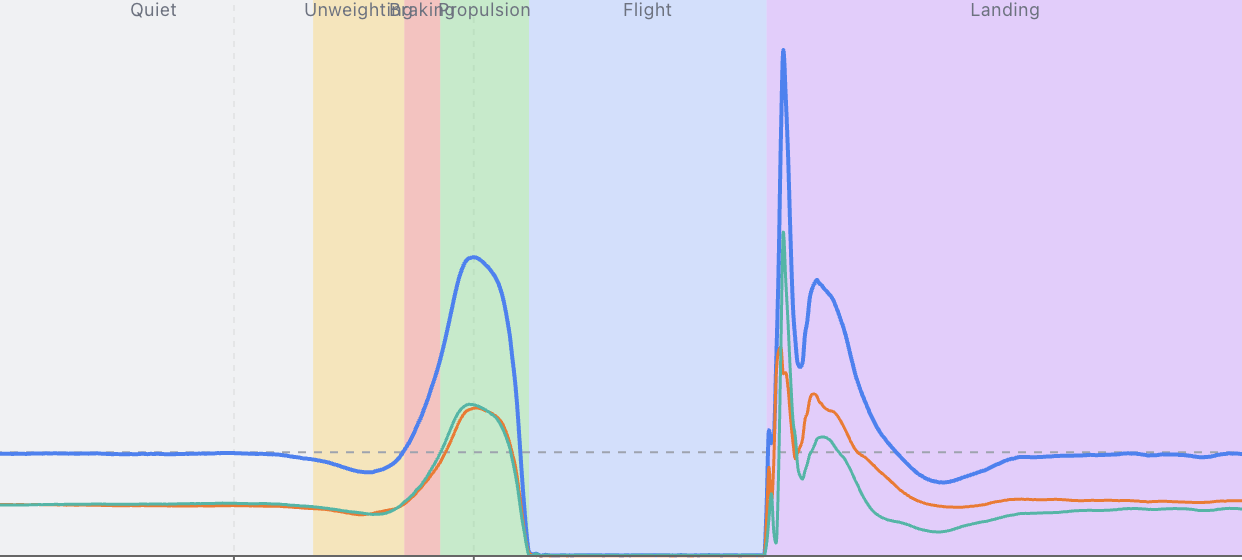
这一点值得单独讲,因为它决定了阈值不能按直觉去设。 This is worth its own section, because it determines why the threshold can't be set by intuition.
通常的说法是:CMJ 比 SJ 跳得高,因为下沉储存了弹性势能。按这个逻辑,下沉必须大到能明显拉长肌腱才会污染 SJ——体重 750 N 者下沉 37 N,显然远不足此。我们起初正是如此判断,因而准备放宽阈值。 The usual story is that a CMJ beats an SJ because the dip stores elastic energy. By that logic a dip must be large enough to meaningfully stretch the tendon before it contaminates an SJ — and 37 N on a 750 N athlete clearly isn't. That was our reasoning too, and it is why we were ready to loosen the threshold.
但 Van Hooren 与 Zolotarjova(2017)的机制综述指出,CMJ 与 SJ 的差距主要不是弹性势能,而是肌肉松弛的消除(串联弹性成分被预先拉紧,向心一开始力就能传递)和兴奋状态的建立(肌肉有时间提高激活水平)。其表述为:差异「主要与肌肉松弛的消除和兴奋状态的建立有关,弹性势能可能也有小部分贡献」。 But Van Hooren & Zolotarjova (2017) show the CMJ–SJ gap is mostly not elastic energy. It is muscle slack uptake (the series-elastic component is taken up in advance, so force transmits immediately) and buildup of stimulation (the muscle has time to raise activation). In their words: the difference "may primarily be related to the greater uptake of muscle slack and the buildup of stimulation … elastic energy may also have a small contribution."
这两个机制被极小的动作就能触发,远小于储存可观弹性势能所需的幅度。因此以「是否足以储存弹性势能」为标准,阈值必然设得过松。这也解释了为何 2% 这样小的幅度,实验上已能测出高度变化。 Both are triggered by very small movements, far below what stores appreciable tendon strain energy. A threshold set to catch elastic energy storage would therefore be far too permissive — which is why something as small as 2% already produces a measurable change in height.
青少年和中年业余爱好者:文献没有答案Youth and middle-aged recreational athletes: the literature has no answer
这是实践中最需要指引的地方,也是文献最沉默的地方。我们找不到任何已发表来源为这些人群规定更宽松的阈值: This is where practitioners most need guidance and where the literature is most silent. We found no published source sanctioning a looser threshold for these populations:
- Agar-Newman 等(2025)的样本是 22.2 ± 1.5 岁的大学女子橄榄球运动员,没有年龄分层,性别与项目的推广性论文中亦存疑。 Agar-Newman et al. (2025) sampled university female rugby players aged 22.2 ± 1.5 y, with no age stratification; the authors themselves flag gender and sport generalisability.
- Petrigna 等(2019)专门是青少年(12–18 岁)的标准化综述,仍然只说「有反向下沉的跳跃应剔除」,既没给数值,也没为青少年放宽。 Petrigna et al. (2019) is specifically an adolescent (12–18 y) review and still says only that jumps with a countermovement should be discarded — no number, no youth tolerance.
- 中老年运动者(masters)文献记录了 SJ 信度差于 CMJ(CV 5.6–27.5% 对 3.9–15.7%),与「保持姿势更困难」一致,但作者当作测量变异报告,未据此放宽标准。 Masters literature documents worse SJ reliability than CMJ (CV 5.6–27.5% vs 3.9–15.7%), consistent with difficulty holding position — but reports it as measurement variability, not grounds for a relaxed criterion.
困难有据可查,宽容度则无。我们取 5% 而非 2%,正是因为在这一空白之下,废弃大量试次的代价高于容忍一个 trivial 效应。 The difficulty is documented; the tolerance is not. We chose 5% over 2% precisely because, in that gap, the cost of invalidating a large share of trials exceeds the cost of tolerating a trivial effect.
还不知道的What we still don't know
- 下沉对力、功率、速度的影响未知。该研究只考察跳跃高度一个结果指标,此为其列出的局限之一;力-速度剖面是否同样受影响,尚无数据。 The effect on force, power and velocity is unknown. The study examined only jump height — a limitation the authors list themselves — so whether force–velocity profiling is affected the same way has not been tested.
- 青少年与中年业余爱好者的适用阈值——没有任何已发表数据。这是一个真实的研究空白。 The appropriate threshold for youth and middle-aged recreational athletes — no published data at all. A genuine research gap.
注:本文的百分比均以系统重量(安静阶段力台读数)为分母,与 Hawkin 一致;自重 SJ 中它等于体重,加了负重或换成其它等长姿势则不然。Agar-Newman 等(2025)以体重为分母,负重条件下两者不等价。 Note: percentages here are of system weight — the plate reading during the quiet phase — as Hawkin uses. For a bodyweight SJ that equals body mass; with added load or another isometric position it does not. Agar-Newman et al. (2025) used body mass, which is not equivalent under load.
参考文献References
- Agar-Newman DJ, Funk S, Cavin E, Geneau MC, Tsai M-C, Klimstra M. Determining the Threshold of Unweighting in Squat Jumps: A Study on Jump Height and Unweighting Amplitude. J Strength Cond Res 39(3):295–299, 2025.
- Van Hooren B, Zolotarjova J. The Difference Between Countermovement and Squat Jump Performances: A Review of Underlying Mechanisms With Practical Applications. J Strength Cond Res 31(7):2011–2020, 2017.
- Petrigna L, et al. A Review of Countermovement and Squat Jump Testing Methods in the Context of Public Health Examination in Adolescence. Front Physiol 10:1384, 2019.
- Owen NJ, et al. Development of a Criterion Method to Determine Peak Mechanical Power Output in a Countermovement Jump. J Strength Cond Res 28(6):1552–1558, 2014.
- Hawkin Dynamics. Best Practices for Squat Jump Testing on Force Plates; The Difference Between the Countermovement Jump & Squat Jump.